





Safe by design: why staircase safety deserves greater attention
Contents |
[edit] The challenge of safety by design
Each year, thousands of people are injured by falls on the stairs. The Royal Society for the Prevention of Accidents (RoSPA) reports that over 300,000 people visit A&E departments annually following a fall on the stairs, with more than 43,000 hospitalisations and hundreds of fatalities attributed to such accidents. These figures underscore the urgent need to prioritise staircase safety as a fundamental element of building design and maintenance.
The challenge for architects, designers, and specifiers lies in balancing aesthetics with performance, ensuring that visual impact never compromises user safety. Compliance with Building Regulations Part K – which covers protection from falling, collision and impact – is the minimum expectation. Beyond compliance, however, lies a professional responsibility to embed safety by design and reduce the risk of injury long before the first step is taken.
[edit] Understanding the risks
Falls on stairs most commonly occur in descent, when users lose balance and fall backwards or slip down the nosings of steps. Inadequate lighting, uneven treads, or missing handrails all increase the risk of serious injury. Research from the British Woodworking Federation (BWF) highlights that nearly one-third of stair accidents are linked to poor maintenance or broken safety features, including damaged handrails and worn surfaces.
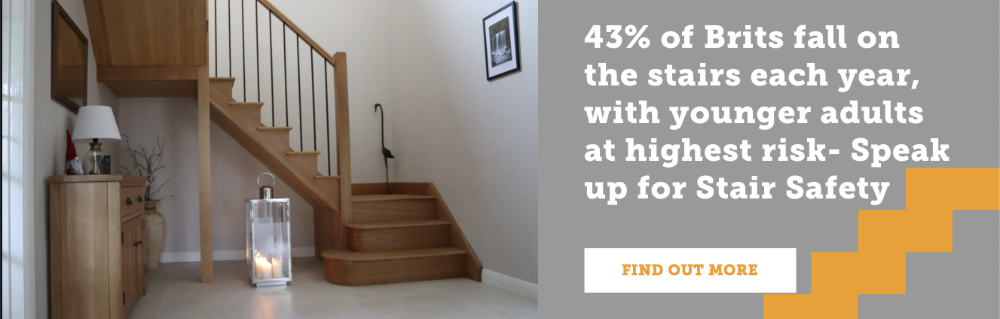
Perhaps surprisingly, younger adults are reporting falls more frequently than older people, with 60% of those aged 18–34 saying they have slipped or tripped on stairs in the past year. This trend is partly linked to modern lifestyles; distraction from mobile devices, rushing, or carrying items up and down stairs. However, while younger people experience more accidents, older individuals are at higher risk of fatal injury, with over 850 deaths of those aged 65+ recorded in 20231 due to falls on stairs and steps.
[edit] Designing safety into every step
The geometry and proportion of a staircase are crucial determinants of its safety. Even minor inconsistencies in its dimensions can lead to under-stepping or over-stepping - a variation of more than one percent in rise or going can cause a person to trip or misstep, particularly when their movements are based on the rhythm established by the first few steps.
Staircases with open rises should be carefully designed to prevent horizontal gaps between treads and ensure that vertical spaces are small enough to reduce risks for children. Handrails are another critical safety feature allowing users to stabilise themselves within moments of losing balance. They should remain within easy reach along the entire flight, ensuring continuity of support. Similarly, adequate guarding must be provided: strong enough to resist weight and designed to prevent a person from falling over or through it.
The surface finish of treads also demands attention. Worn coverings or smooth finishes can significantly increase the likelihood of slips, particularly where the going is less than 300mm. A slip-resistant nosing can convert what might have been a severe fall into a minor stumble - especially when paired with a well-positioned handrail.
[edit] From guidance to good practice
Many risks can be mitigated by embedding best-practice design standards from the outset. While adherence to Part K provides a regulatory baseline, voluntary adoption of higher standards such as British Standard 5395-1 can cut stair-related falls by up to 60%. Adopting such standards universally would represent a significant step forward in preventing avoidable injuries.
Safe staircase design must go hand-in-hand with proper installation, maintenance, and user awareness. The BWF’s Speak up for Stair Safety campaign is calling for all professionals involved in building design, construction, and refurbishment to prioritise these principles - embedding uniform step sizing, non-slip materials, secure handrails, and effective lighting as standard practice, not optional extras.
[edit]
While design sets the foundation for safety, behaviour also plays a critical role. Many accidents occur when individuals are distracted, rushing, or carrying objects that prevent them from holding the handrail. In fact, despite 84% of people acknowledging that device use increases the risk of falls, nearly a third admit to scrolling social media (31%) or using a messaging app (29%) while on the stairs. Encouraging safer habits can significantly reduce the likelihood of falls.
Ultimately, staircase safety is a collective responsibility shared by designers, builders, and occupants alike. A well-designed staircase does more than connect spaces; it protects those who use it every day. By applying thoughtful design, adhering to best-practice guidance, and promoting responsible use, the risk of injury can be dramatically reduced.
1 Mortality statistics - underlying cause, sex and age - Nomis - Official Census and Labour Market Statistics - ICD-10 code W10 used for falls from stairs and steps.
This article was provided the BWF Stair Scheme and was by written by Helen Hewitt, CEO of the British Woodworking Foundation.
--British Woodworking Federation
[edit] Related articles on Designing Buildings
- Accommodation stair
- Approved Document B
- Approved Document K
- Approved Document M
- Evolving fire door testing standards
- Flight.
- Guarding
- Landings in buildings
- Maximum length of a flight of stairs
- Means of escape
- Protected stair v escape stair
- Protected stairway
- Railings
- Spiral stairs and helical stairs
- Stair design.
- Stairs going
- Stairs nosing
- Stairs riser
- Stairs tread
- Types of stairs
- Width of doors stairs and escape routes
Featured articles
Check out some of the best features and news from Designing Buildings as well as key stories from around the web.
Introduction to radon awareness

New technical information sheet published by CIOB.

Updated supplier guide can help electrical contractors engage with NHP.

CIAT confirm the winners of the 2026 architectural technology awards.

Government launches a one stop shop for flood preparedness.

Sir Edwin Lutyens: Britain's greatest architect? Book review.

CIOB publishes free template to help assess and manage risks.
ECA's reflections on Party Conference season

Burnham wants to be confident of winning before asking for a fresh mandate.
New Chief Construction and Scientific Adviser

Sergio Cavalaro, Professor of Infrastructure Systems at Loughborough University.
Building safety levy for England

CIAT publish estimator tool for members.

Water sector faces a growing crisis that could slow the delivery of vital infrastructure.
Undervaluing our industrial past

Heritage value changes as taste for building styles changes.
Changing expectations around competence and compliance

New information sheet from CIAT.
Comments